



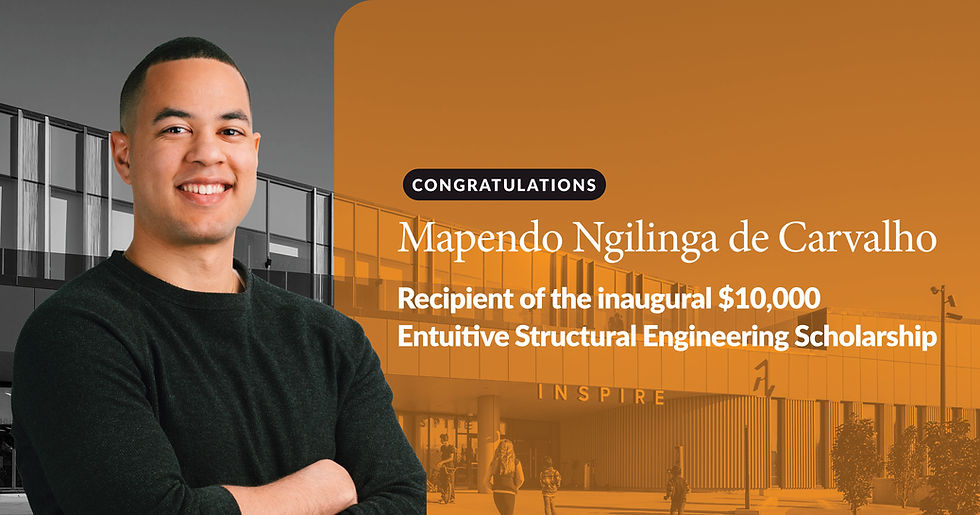
Meet Mapendo Ngilinga de Carvalho, the First Winner of the Entuitive Structural Engineering Scholarship
Fifteen years ago, we set out to build a firm where creativity and technical excellence go hand in hand. To mark our 15th anniversary earlier this year, we launched the Entuitive Structural Engineering Scholarship to invest in the next generation of engineers who will carry that thinking forward.
Today, we're proud to introduce the first winner: Mapendo Ngilinga de Carvalho, a Master's candidate at the University of Waterloo.
As the winner of the scholarship, Mapendo receives $10,000 in tuition support.
What we asked, and what we heard
Applicants were asked to write about a structural engineering challenge where AI could be transformative. We received applications from 15 universities across Canada, and the thinking was impressive. Across the strongest essays, a few ideas came up again and again:
AI assists, the engineer stays accountable. Applicants were optimistic about AI, but clear that the licensed engineer owns the decision.
Trust must be earned. Good data, visible assumptions and independent checks matter as much as the technology itself.
Time back for better work. Handing off repetitive tasks gives engineers more room for judgment, creativity and collaboration.
Connected information. Many saw AI helping teams catch conflicts between disciplines earlier, when they are easier and cheaper to resolve.
More options, better outcomes. From embodied carbon to concrete mix design, applicants saw AI helping engineers explore far more solutions before committing to one.
Why Mapendo stood out
Mapendo's essay argued that AI's most valuable role in structural engineering is turning fragmented engineering knowledge into data-driven decisions.
Instead of hunting for design procedures, moving information between programs, and repeating calculations, engineers could spend more time on the judgment calls that matter. He wasn't writing in the abstract. He has built two software tools to explore the idea: Noem, an engineering workspace that captures the thinking behind a calculation, and EIME, a Python library that lets formulas carry their units, sources and assumptions.
Just as important, Mapendo insists the work stay transparent, so engineers can trace and challenge every result. When we talked with him, he explained why:
"We have a professional obligation to the public to exercise independent judgment, act with integrity, and put human safety first, and we can’t do that if we’re blindly trusting black box software.” -Mapendo Ngilinga de Carvalho
His commitment to the profession runs well beyond the essay.
Mapendo is completing an experimental master's thesis at University of Waterloo, developing a new design factor for a future edition of the CSA S6 code. He led a team through a private research contract involving more than 50 experiments, earned a TA Excellence Award for guiding architectural engineering students, and took the podium on three different engineering design competitions.
Congratulations, Mapendo. We can't wait to see what you build.