


Navigating BC's Sustainability Requirements
An interview with Entuitive sustainability experts Luisa Drope and Oscar Valdes
British Columbia’s sustainability landscape is evolving rapidly, with Vancouver's stringent requirements around energy performance, embodied carbon, and climate resilience at the forefront. For project teams, meeting these standards while staying on budget can be a challenge.
We interviewed Luisa Drope, Senior Building Performance Analyst, and Oscar Valdes, Senior Decarbonization Consultant, to discuss how Entuitive helps clients navigate these complexities with practical strategies driven by energy efficiency at the outset.
Vancouver’s sustainability requirements are among the most progressive in Canada. How do you help clients make sense of them?
Luisa: First, we clarify which regulations apply to their specific project. The project targets and regulations depend on building type, location, and who will own the building. For instance, City-owned projects often have stricter targets for embodied carbon and climate resilience. Additionally, the building code varies by location, and a project in Vancouver, for example, will follow the Vancouver Building By-law (VBBL), not the BC Step Code. Our local expertise allows us to decode these differences and guide clients through the process efficiently.
Oscar: That’s correct. The City of Vancouver has introduced new requirements around embodied carbon and resilience. We’ve developed a streamlined approach to climate resilience that’s a bit different from the industry norm. Instead of relying solely on prescriptive checklists, we integrate resilience into the design – looking at passive strategies, material durability, and occupant health. It’s practical, scalable, and tailored to Vancouver’s climate risks.
We focus on early-stage decisions. For embodied carbon, we’ve built a local materials database to help us identify cost-effective, low-carbon options. We also work closely with structural and architectural teams to optimize systems – sometimes a small tweak in layout or material choice can yield big carbon savings. Our goal is to reduce emissions without adding complexity or cost.
With multiple sustainability targets, how do you effectively help clients meet the code and their goals while keeping the budget in mind?
Oscar: We focus on early-stage decisions. For embodied carbon, we’ve built a local materials database to help us identify cost-effective, low-carbon options. We also work closely with structural and architectural teams to optimize systems – sometimes a small tweak in layout or material choice can yield big carbon savings. Our goal is to reduce emissions without adding complexity or cost.
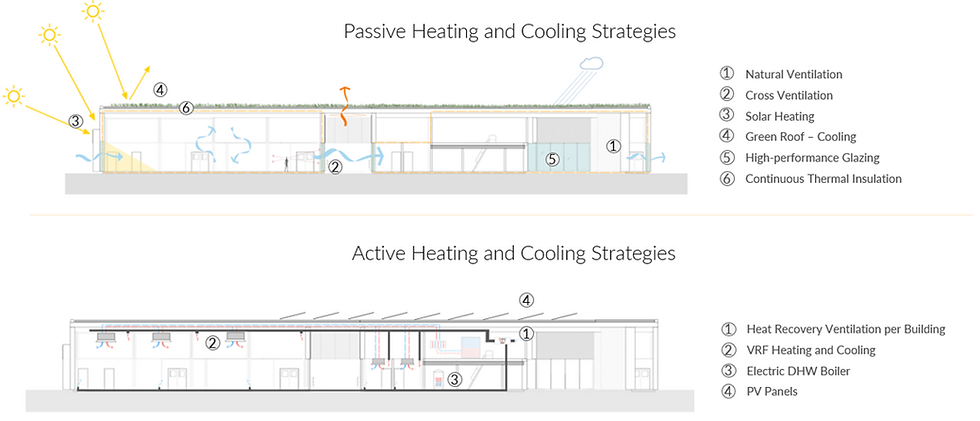
Luisa: Yes, focusing on early-stage decisions has the biggest impact on cost. Sometimes, small design changes can have a huge impact on a building's performance. So we check where the insulation layer is, how the spaces are conditioned, and test different envelopes and mechanical strategies. However, our approach goes beyond achieving compliance; it’s about aligning with the project's core values. We assist clients in integrating customized sustainability strategies, sometimes including Indigenous perspectives, or green building certifications such as LEED or CaGBC Zero Carbon Building Standard if desired.
Vancouver also has requirements for existing buildings. How does Entuitive support retrofit projects?
Oscar: The City’s Existing Building Strategy is pushing for deep carbon retrofits, especially in public
infrastructure. We’ve helped clients assess baseline emissions and develop phased retrofit plans that align with funding and operational realities. One recent project involved electrifying a legacy building while preserving its heritage features – we reduced operational carbon by over 40% without compromising its identity.
Luisa: Retrofits are where our integrated approach has its largest impact. We look at energy, carbon, and resilience together. For example, envelope upgrades will improve resilience and lower energy consumption, while switching to electric heating will have a huge impact on reducing carbon emissions in existing buildings. This kind of foresight helps clients make informed decisions that balance sustainability, performance, and budget.
What sets Entuitive apart in this space?
Oscar: We’re local. We understand Vancouver’s unique policies, climate, and construction market. Our clients face fewer surprises, which often means smoother approvals. We’ve also contributed to industry working groups that shape these standards, which means we often know what’s coming before it’s official.
We also frequently collaborate with clients who typically work in other jurisdictions but are taking on projects here in Vancouver. We help them navigate the local context, which can include adjusting their designs and strategies to align with regional requirements, sustainability targets, and best practices.
Luisa: And we’re collaborative. Our envelope, structural, and sustainability practices often work as one team. We don’t just deliver reports – we work with clients to shape strategies that reflect their values. Whether integrating innovative practices, pursuing certification, or reducing long-term costs, we make sustainability meaningful and achievable for our clients.
Thank you both for taking the time to speak to us about BC's sustainability requirements!