


Interconnected Floor Spaces: Balancing Tenant Appeal with Code Compliance
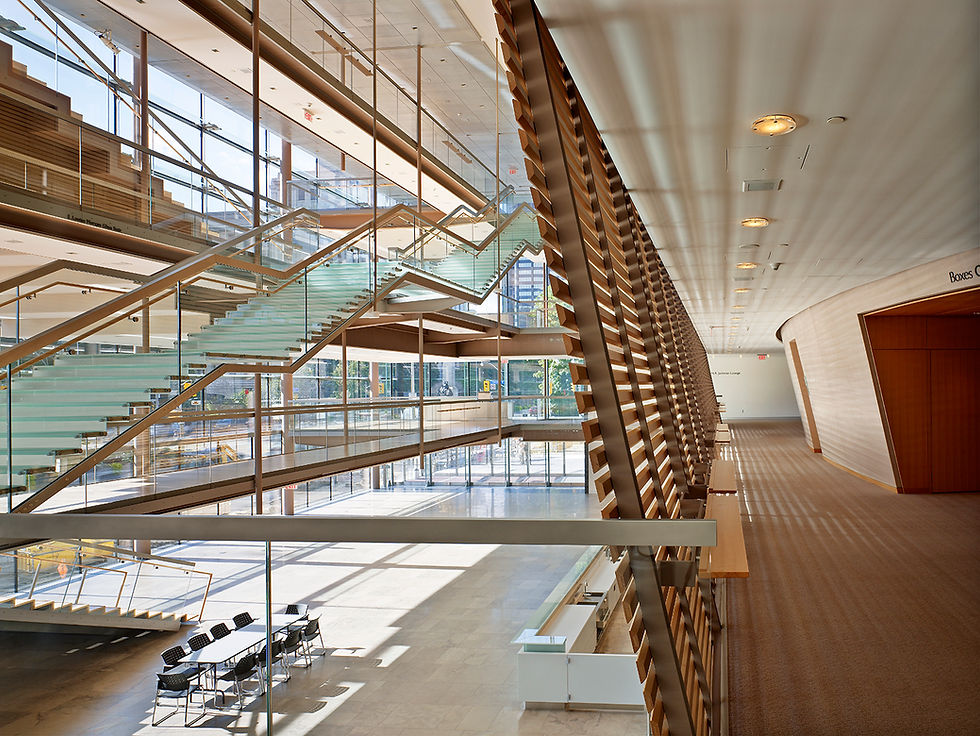
For building owners and managers, tenant experience and safety are two sides of the same coin. Design features such as interconnected stairways can make a space more attractive to prospective tenants by creating a sense of openness, connectivity, and prestige. These can range from simple functional stairs between floors to complex and grandiose atrium staircases.
However, whether they’re new or existing, connections between floors can also introduce complex structural, fire safety, and code compliance challenges. If overlooked, the challenges can add risk, cost, and delays when leasing or reconfiguring space.
Understanding how interconnected stairways are treated under the building and fire codes is essential when modifying existing properties, planning capital improvements, or preparing a space for new tenants. By approaching these features proactively, building owners can maximize leasing potential, protect investments, and ensure the long-term resilience of their assets.
Expert guidance in code consulting, fire safety planning, and structural design provides owners and managers with expertise that reduces risk while supporting on-budget and on-time modifications.
Implications of Interconnected Floor Spaces
Interconnected stairways, also referred to as convenience stairs or communicating stairs, provide a functional internal link between a tenant occupying several floors or the large open atrium at the main entrance to a building or floor space. Beyond the emotions these design features can convey, the features have implications within the building code and fire code.
Adapting to Building Code Updates
Interconnected stairways introduce large openings between floors, or several floors or storeys, located in groups or clusters throughout a large office tower. It’s unlikely the stairs have fire separations at either end to maintain separation between the floors. The building code defines these openings as interconnected floor spaces. At issue is the movement of fire, smoke, heat, and toxic gases produced by a fire traveling through these openings and contaminating other floors.
The building code requires specific tactics for ensuring occupant safety on all connected floors, especially in the event of a fire.
With an interconnected floor area, the building code requires specific tactics for ensuring occupant safety on all connected floors, especially in the event of a fire. These measures include sprinklering the building, protecting exits with vestibules, introducing draft stops around the opening, adding cumulative exit capacity or refuge space within exit stairs, and limiting combustible content in the floor areas.
A critical change specific to Ontario went into effect on January 1, 2025, when OBC 2024 removed an exemption for the protection measures we listed above for interconnected office floors. While there may be more onerous life safety measures without the exemption, the updated code also provides more architectural flexibility as the openings no longer need to stack vertically in a 9-meter-wide cylinder. This demonstrates the importance, regardless of location, of reviewing new or existing interconnected floor spaces for code compliance during renovations, tenant improvements, or reverting spaces back to base building.
Multiple openings, multiple renovations
It is possible to have several different interconnected floor spaces on a single occupied floor that are not aligned vertically. One connection moves down two storeys with a second connection on another part of the floor that moves up three storeys, while a third connection moves up four and down four storeys. How did this happen? Why so many interconnected floor spaces?
This could be a simple design choice of the tenant, or the tenant inherited the staircases when they took over other floors. As their business grew so did their occupancy within the building and they decided to join their floors.
What are the implications to the structure of the floor plate. or to the building in general, when joining floors? The building was not designed to have all these interconnections, so it’s uncertain how will it perform. This compounds the life safety aspect as it must be understood how these interconnections impact each other and how a holistic life safety strategy is still maintained for the overall tenant space.
Sounds Structures for Deflection and Vibration
A review of the interconnected floor space design must be conducted from a structural perspective to ensure not only that the floors can support the imposed loads, but that the stair meets all deflection and vibration criteria to ensure that it’s comfortable for tenants.

Fire Alarm Activations and Fire Safety Planning
Another major consideration that must be examined is how the floor openings will affect the fire alarm sequence of operations. A typical fire alarm activation sequence for a high-rise office tower would be the floor in alarm, the floor below the alarm, and the floor above the alarm. Interconnected floor spaces are considered as one floor.
If we consider the previously discussed floor connection scenario that moves up four stories and down four storeys, we now have nine interconnected floors receiving evacuation signals from the initial floor in alarm. Since the floor above and below would also receive the signal from the interconnected floor, a total of 11 floors in the office tower would be under the evacuation alarm. If the floor above or below also has interconnected floors, the evacuation signal would further expand. This can create an incredibly complex alarm and evacuation signal for both building occupants and first responders to decipher.
During a fire alarm activation, other ancillary systems or interconnected systems will also be affected by the alarm activation, such as:
Elevators and escalators
Exhaust fans
Atrium fans
Electromagnetic locking devices
Door hold-open devices
Fire doors and gates
Above and below grade pressurization fans
These integrated systems may have been localized to one area of a tower but now due to the interconnections may have a far larger area of effect and more building occupants being affected. Regardless of the orientation, it is critical that the fire safety plan and life safety systems accurately account for the interconnected floors and remain up to date.
Return to Base Building
When a tenant moves out of a space leaving multiple interconnected floors, the floors can be left as-is hoping a new tenant will take all floors as-is, or they can be infilled. Each of these examples have implications to the building owner. Regardless, it is likely the spaces will undergo a renovation as defined by code and the code compliance of these interconnected spaces must be reviewed. Infilling the floors is equally complex as now the fire alarm and other integrated systems must be re-evaluated.
Interconnected Floor Spaces
Convenience or communicating stairs are not that convenient when viewed from the perspective of the building or fire codes. They pose a challenge to the structure and life safety of the building because they act as large openings in the floor plate connecting numerous floors. These designs add complexity to the sprinkler system, the building’s smoke control system, smoke and/or fire barriers, and the evacuation of building occupants.
Other integrated life safety systems must be examined and the implications that will exist during an emergency. And what happens when those interconnected floors no longer serve their purpose? How do we remove them from the building? These are some of the factors that must be considered when looking at an interconnected stairway design.
Entuitive provides holistic solutions for existing buildings with interconnected floors, including new design and renovation, and returning to base building. These solutions include building code compliance, fire safety planning, and structural design.
For more information, reach out to Mike Power, Matt Smith, or Tom Jennings.