


Lake Shore Bridge Extension Supports Toronto’s Richest Real Estate Opportunity
Updated: Sep 23
The largest and most valuable development opportunity in North America – Toronto’s waterfront – is undergoing a transformation that will fulfill its potential to revitalize the 800-acre Port Lands area, creating crucial infrastructure to drive economic and housing growth. Waterfront Toronto is leading the transformation, collaborating with all three levels of government and industry to resolve any larger issues that impede progress.
One of the most significant challenges facing the project was the condition of the lands and infrastructure at the south end of the Don Valley, where the Don River outlets into Toronto Harbour and where the critical transportation artery that is the Don Valley Parkway meets Lake Shore Boulevard East. Prone to annual flooding and designed for a Toronto that no longer exists, this area required considerable work to enable the future residential and commercial development opportunities of Toronto’s presently industrial Port Lands area.
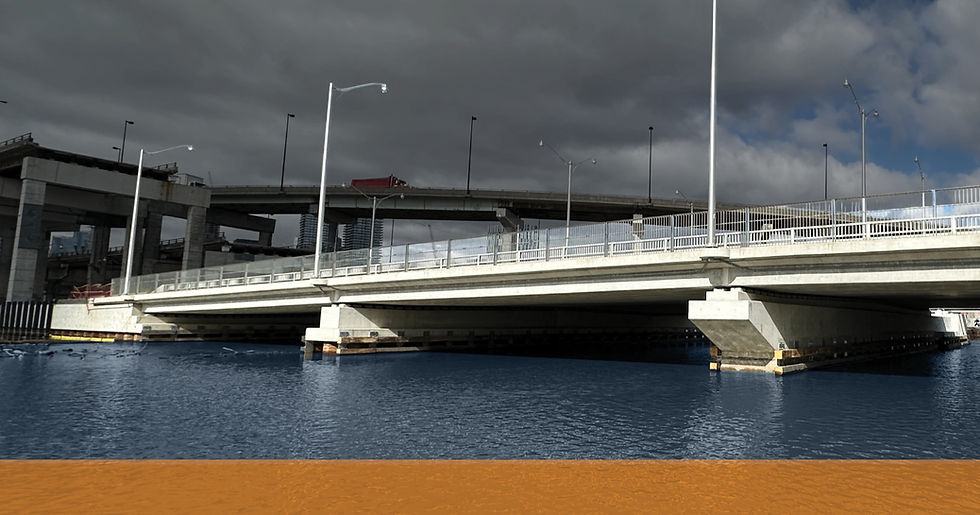
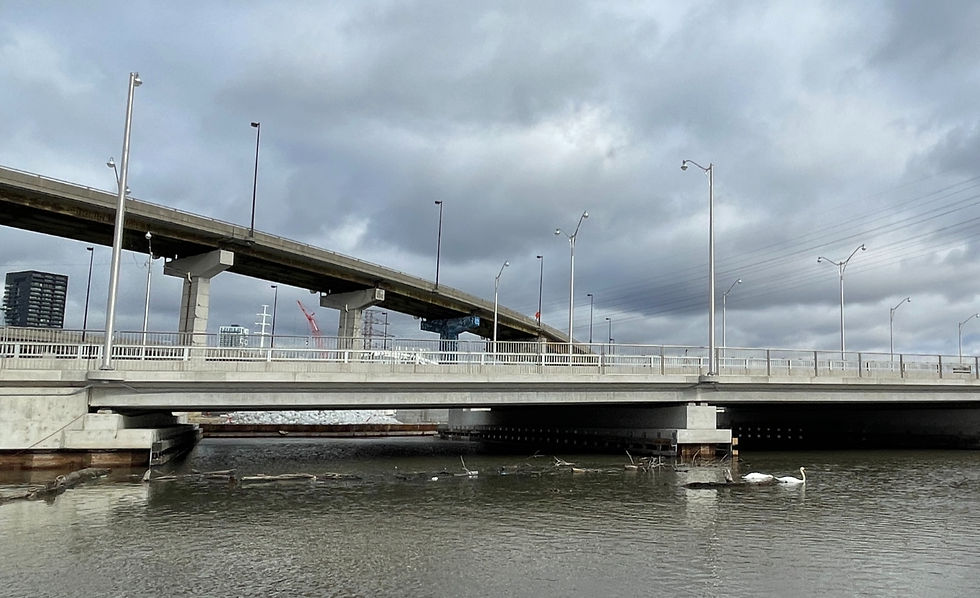
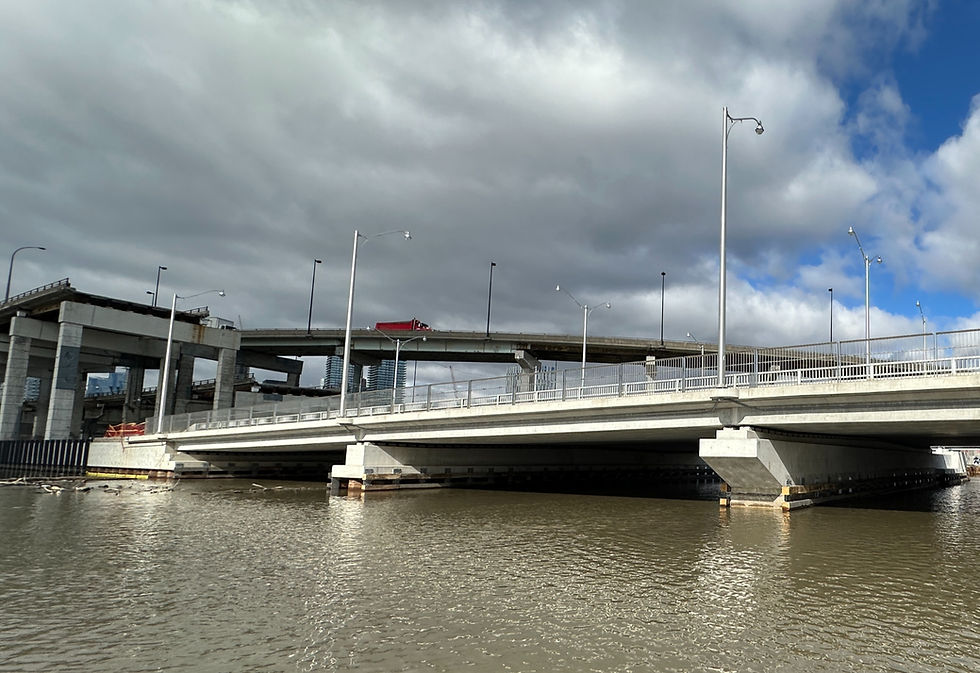
Entuitive was retained by EllisDon to engineer a solution that would mitigate the flooding of the adjacent Don River and that would increase the capacity of the Lake Shore East Bridge to suit increased traffic volumes that are anticipated with continuing development of the Port Lands area. Our team approached this collaboration with a creative, client-oriented mindset, utilizing the City’s existing structural assets to solve project challenges at a much lower cost. The result was a hybrid solution for the Lake Shore East Bridge that rehabilitated and reused the existing bridge’s abutments and pier, while replacing the superstructure and adding a new abutment and pier to lengthen the bridge and widen the mouth of the Don River. Bridge construction was completed in spring 2026.
The successful extension of the Lake Shore East Bridge and the widening of the mouth of the Don River has already mitigated flooding during heavy rains and provided the Port Lands area with enhanced traffic capacity that supports current and future developments.
Andrew Lehan, an Associate on Entuitive’s Bridge Engineering Team and Engineer-of-Record for the Lake Shore East Bridge, generously shared his time to speak with us about this vital Toronto waterfront project.
Lake Shore Bridge Extension for Waterfront Toronto
Entuitive: What issue did Waterfront Toronto want to solve for this Port Lands project?
Andrew Lehan: Waterfront Toronto wanted to reduce the likelihood of upstream flooding in a major storm event by creating more hydraulic capacity for the Don River. We needed to open up the mouth of the river to increase water flow, which meant having to lengthen the Lake Shore East Bridge to accommodate the river widening.
EN: Floods caused by heavy rain used to be relatively common just north of that area before you exit the Don Valley Parkway (DVP).
Andrew Lehan: Yes, that lower part of the DVP – a few minutes south of the Bloor Viaduct – is on a bit of a plateau that’s low to the river, so it used to be quite vulnerable to flooding. One of the consultants that we worked with, MVVA, performed a hydraulic analysis that determined a required hydraulic opening of about 100 metres at the Lake Shore East Bridge to mitigate upstream flooding.
EN: Widening the river mouth to a 100-metre opening required the lengthening of the bridge.
Andrew Lehan: The existing bridge had two 24-metre spans, so we needed to effectively double its length to achieve the required hydraulic opening. The big question was whether we would reuse the 60-year-old abutments and pier in the new bridge. Doing so would allow for the bridge spans to remain short and economical, but it would also mean living with the constraints and costs associated with restoring older structural elements of a different vintage.
Efficient Solutions for Project Challenges
EN: What solution was implemented to mitigate the cost of delivering project objectives in this less-than-ideal job site?
Andrew: Reusing the existing pier and both abutments of the existing bridge proved to be the most economical solution. Constructing entirely new piers and abutments would have been very costly at this site.
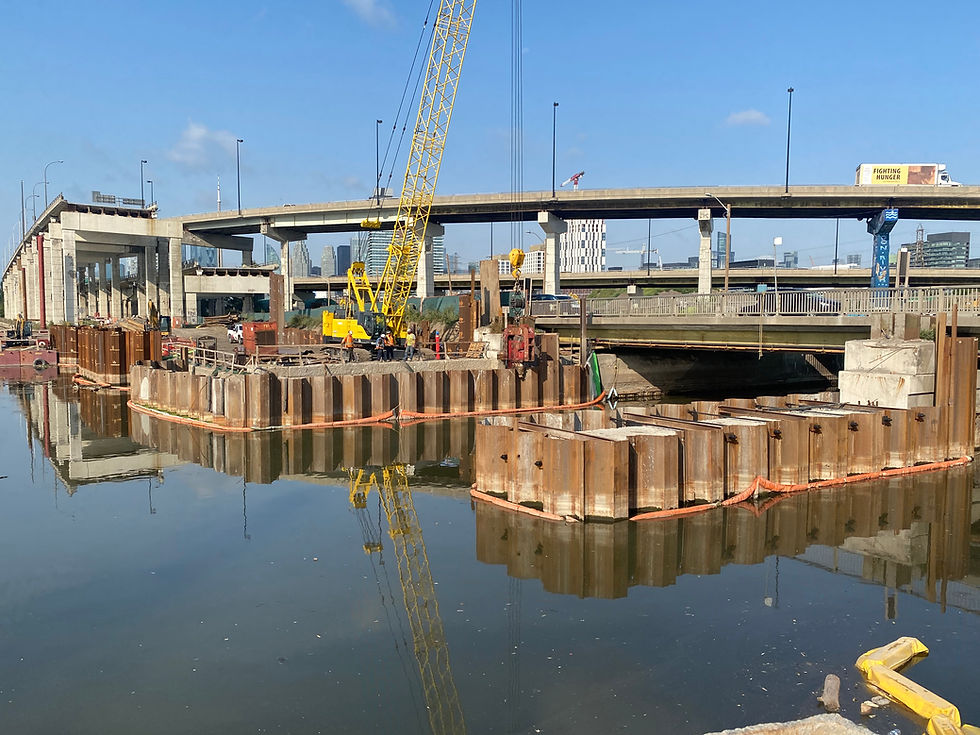
The centre pier of the existing bridge was transformed into the east pier for the new bridge, while the west abutment of the previous bridge became the centre pier of the new bridge. A new west pier and west abutment were constructed on land instead of new piers constructed in the river. The land between west abutment and centre pier was eventually dredged to open the river mouth.
EN: Essentially, leveraging the existing piers and abutments and building a new pier on land avoided the expense of building in the river.
Andrew: That’s right – there was land we could work on further west of the original west abutment. We basically precluded the need to go out into the water to construct a new pier, which would have happened if we abandoned the existing one and proceeded with all new piers.
EN: What causes new pier construction to be particularly expensive?
Andrew: Access to the work site and demolition costs. New pier construction would have to take place in the river, so you would need a piling rig on a barge to install new foundations for the piers. Dewatering efforts would also have been greater for constructing a new pier cap in the river versus on land.
Using new piers would have meant removing the existing pier and abutments. Those removals would have resulted in performing costly underwater demolition operations.
All the efforts to construct new piers and remove the existing pier and abutment would have extended the project schedule, which would have added direct costs to the project and indirect costs to the public in the form of longer traffic disruptions in the area.
Strategic Approach to Technical Solutions
EN: What enables our team to recommend creative solutions that clients have not envisioned or explored?
Andrew: We don’t approach projects with predetermined tools or processes.
We don’t visit client offices and say, “I have a hammer in my hand, so we better use nails, not screws.” Instead, when we collaborate with clients, we listen to their needs and we examine the available data and information to align our project processes our clients’ objectives. Figuratively, an analysis might show that nails are optimal for some parts of the project while screws work better for other project elements. So, we’ll bring both our screwdriver and hammer, instead of insisting on hammering screws into place. It’s about doing what’s right for the client.
Technical solutions we create are obviously more complex than hammering nails and fastening screws, but the idea behind our approach stays consistent. We help our clients solve problems by applying our technical skill in a strategic way, analyzing the different elements of the project, and understanding how the solution impacts outcomes for our clients.
EN: The existing site is quite complicated. Were there any other notable design challenges experienced by the design team?
This project was a great opportunity to flex our engineering capabilities because of the additional seismic requirements we needed to comply with. Typically, bridge projects in Toronto don’t need to satisfy strenuous seismic requirements because Toronto is located in an area of low seismic activity. However, the Lake Shore East Bridge was found to have a pesky layer of soil beneath it that was deemed liquifiable under excitation from the lower magnitude earthquakes that Toronto is at risk of experiencing. As such, we needed to detail the structure with superior ductility, which became a challenging retrofit for the existing pier and west abutment, one that required installing large diameter post-tensioning bars down through the existing concrete into the underlying bedrock.
It’s great to have the opportunity to engineer these types of creative solutions. Some projects are ideal for a conventional, cookie-cutter approach – and there’s a genuine need for that type of delivery – but I love it when we get to sharpen our pencils and engage in strategic thought for our designs.